What are Checks and Balances?
Mechanisms preventing any single branch from exercising unchecked power, fostering interdependence and accountability.
What if the very structure of our government was designed to prevent any one person or group from having too much power? This foundational idea is what checks and balances are all about. Let's explore how this system safeguards our democracy and ensures that every voice is heard.
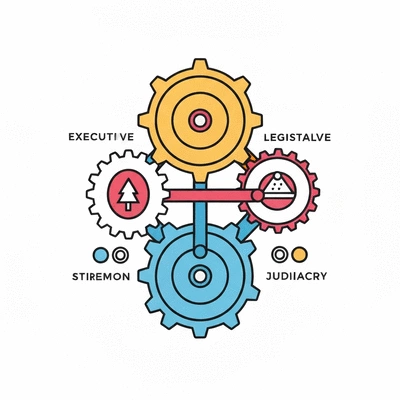
This visual outlines the core functions and interdependencies of the three branches of government, illustrating how each branch checks the power of the others to maintain balance and prevent abuse of authority. For a deeper dive into how government decisions are made, explore how government leaders make decisions.
Mechanisms preventing any single branch from exercising unchecked power, fostering interdependence and accountability.
Makes Laws
Enforces Laws
Interprets Laws
Protects democratic values, ensures government accountability, and prevents concentration of power.
Checks and balances are fundamental principles in our governmental system designed to ensure that no one branch of government becomes too powerful. This system is crucial for maintaining the integrity and fairness of our democracy. By distributing power across different branches, we can protect against the abuse of authority and uphold democratic values.
At Next In Office, we believe that understanding these concepts is essential for informed civic participation. So, let’s break it down together and see how checks and balances work in practice!
Checks and balances refer to the mechanisms that prevent any one branch of government—be it the legislative, executive, or judicial—from exercising unchecked power. Each branch has some measure of influence over the other branches, creating a system of interdependence. This means that for one branch to take action, it often needs the approval or cooperation of another, thereby ensuring a balance of power.
For example, while Congress makes laws, the President has the power to veto them. This interplay not only promotes accountability but also fosters a collaborative approach to governance. It’s all about keeping each other in check!
A great way to think about checks and balances is to imagine a well-coordinated team playing a sport. Each member has a specific role, like a quarterback in football or a point guard in basketball. While one player may be in the spotlight, every other player is crucial in supporting their efforts to achieve the team’s goals. If one person tries to take control of the game entirely, it can harm the team’s overall performance.
This analogy highlights how each branch functions independently yet relies on one another to maintain a balance that serves the public interest.
The separation of powers is a foundational concept in our government structure. It articulates that power is divided among different branches, each with its own distinct responsibilities. This division is crucial because it helps prevent the concentration of power, which can lead to tyranny.
By separating governmental functions, citizens can hold each branch accountable for its actions. This structure encourages transparency and fosters trust between the government and the people.
Democracy thrives when citizens are engaged and informed about how their government operates. At Next In Office, we are dedicated to providing clear explanations about political processes, such as checks and balances. This understanding empowers citizens to participate actively in their government, ensuring that their voices are heard.
Federalism adds another layer to the separation of powers by dividing authority between national and state governments. Each level has its own responsibilities, which can sometimes overlap but are generally distinct. This distribution creates additional checks on power, allowing for local governance that reflects the specific needs of communities. To learn more about how federalism shapes daily life, consider exploring how it impacts federal and state offices compared.
Through federalism, we can maintain a balance that respects the diversity of our country while promoting cohesive governance.
The legislative branch, primarily made up of Congress, plays a vital role in creating laws that govern our society. One of its essential functions is to provide checks on the executive and judicial branches. For instance, while the President can issue executive orders, Congress has the authority to legislate against them if they believe those orders overstep the bounds of power.
This dynamic ensures that no single branch can operate without scrutiny or accountability. By fostering a culture of debate and discussion, the legislative branch helps to clarify the intentions of laws and policies.
Two powerful tools in the legislative branch's arsenal are the veto and budget control. The President can veto legislation, but Congress can override that veto with a two-thirds majority in both houses. This illustrates the checks in place to prevent unilateral action from the executive branch.
Such checks are critical in upholding the principle of shared governance and reflecting the will of the people.
The executive branch, led by the President, is responsible for enforcing laws and administering the government. However, it is not free from checks. The legislative branch can impeach a President, while the judicial branch can review the constitutionality of executive actions.
This oversight ensures that the executive branch remains accountable to the people and does not act beyond its authority. The checks in place create a governance structure that prioritizes fairness and justice.
Impeachment is one of the most significant checks available to Congress against a sitting President. This process acts as a safeguard against misconduct, ensuring that the executive remains accountable.
These examples highlight the interconnected nature of our branches and the importance of collaboration in governance.
The judicial branch, primarily composed of the Supreme Court and lower courts, plays a crucial role in interpreting laws and ensuring they align with the Constitution. This branch can check the powers of both the legislative and executive branches through judicial review.
By assessing the legality of laws and executive actions, the courts uphold the rule of law and protect citizens' rights.
Judicial review is a defining feature of the judicial branch. It allows courts to invalidate laws and executive actions that conflict with the Constitution. This power is vital for maintaining the integrity of our democratic system.
The impact of the Supreme Court on American law cannot be overstated, as its decisions shape the understanding of rights and responsibilities for generations to come.
Checks and balances are more than just a structural feature of our government; they are essential for protecting democratic values. By ensuring that power is not concentrated in one branch, we promote fairness and equality under the law.
At Next In Office, we aim to clarify these concepts so that citizens can appreciate their significance and engage meaningfully in the political process.
Accountability is a cornerstone of democracy. Each branch must answer for its actions, fostering a culture of transparency. Without checks and balances, accountability falters, potentially leading to abuses of power.
In real-world governance, checks and balances are vital for maintaining the public's trust. When citizens see that their government operates within a framework of accountability, they are more likely to engage in civic activities, such as voting and advocacy.
Transparency in government fosters accountability. When citizens are informed about the actions of their elected officials, they can hold them accountable for their decisions. Thus, checks and balances serve to ensure that government remains responsive to the people it serves.
While the U.S. employs a unique system of checks and balances, similar principles can be found in democracies around the world. These systems may vary, but the underlying goal remains the same: to prevent the concentration of power and ensure government accountability.
In countries like Australia, checks and balances function through a parliamentary system, where the executive is drawn from the legislative branch. While different in structure, the purpose of ensuring accountability and preventing abuse of power is consistent.
No two systems are identical, and that’s what makes the study of democracy fascinating! Each country’s historical and cultural context shapes its approach to governance. However, the fundamental values of fairness and accountability remain universally relevant.
Federalism, as seen in the U.S. model, plays a critical role in distributing power across different levels of government globally. This arrangement allows for localized governance while still maintaining a cohesive national framework, which can enhance democratic participation.

To truly grasp the significance of checks and balances, consider engaging with local government meetings or town halls. These forums provide a unique opportunity to see how power dynamics play out in real-time and how each branch interacts with the others. By participating, you not only gain insights but also contribute to the democratic process.
Checks and balances are mechanisms in a governmental system designed to prevent any one branch—legislative, executive, or judicial—from becoming too powerful. Each branch has some level of influence over the others, ensuring interdependence and accountability.
They are crucial for protecting democratic values, ensuring government accountability, and preventing the concentration of power, which can lead to tyranny or abuse of authority.
The separation of powers is a foundational concept where governmental authority is divided among different branches, each with distinct responsibilities. This division prevents power concentration and allows citizens to hold each branch accountable.
Federalism adds another layer to checks and balances by distributing power between national and state governments. This division creates additional checks on authority and allows for local governance that meets specific community needs, further preventing centralized power.
Examples include the President's power to veto legislation (checking the legislative branch), Congress's ability to override a presidential veto (checking the executive branch), and the judicial branch's power of judicial review to declare laws or executive actions unconstitutional (checking both legislative and executive branches).
As we navigate through a fast-changing political landscape, the concept of checks and balances remains crucial. Understanding how this system evolves in response to current events is essential for every citizen. I often emphasize the importance of being informed so that we can effectively participate in our democracy. Let’s delve into some contemporary examples and challenges that shape our understanding of this vital principle.
Recent political scenarios have underscored the necessity of checks and balances in keeping power in check. For instance, the controversial impeachment proceedings sparked extensive discussions on the role of the Executive Branch versus Congress. This situation highlights how the branches of government must interact to uphold democratic values, revealing the ongoing relevance of our foundational principles.
These events remind us that the checks and balances system is not just theoretical; it is actively at play in our day-to-day governance. Understanding these elements helps us appreciate their role in maintaining order and fairness in our political system.
Modern challenges such as partisan polarization and increased political rhetoric can strain the checks and balances mechanism. As citizens, we must recognize how these challenges may threaten the integrity of our democratic institutions. For example, when one party dominates both the legislative and executive branches, it can lead to an erosion of accountability.
These factors make it more critical than ever to engage with our political systems actively. By being informed, we can advocate for the necessary reforms that uphold the checks and balances our democracy relies on.
The role of political parties cannot be overstated in the discussion of checks and balances. As I often share at Next In Office, understanding how party dynamics impact governance is key for all voters. Political parties play a vital role in shaping legislation, but they can also create divides that affect how effectively the branches work together. For a deeper understanding of political dynamics, consider third-party candidates in elections and their influence.
Recognizing these influences helps us understand the complexities of our governance and encourages us to advocate for a system that prioritizes collaboration over division. Engaging with the political process is vital, and understanding how elections work, such as understanding US election processes, empowers citizens to make informed decisions and hold their representatives accountable.

Jordan McClure is a civic education writer and political researcher focused on helping readers better understand elections, candidates, government systems, and public policy. Through clear and balanced explanations, Jordan breaks down complex political topics into practical information that everyday readers can understand. His work emphasizes clarity, factual accuracy, and context over opinion, helping citizens stay informed and navigate political topics with confidence.